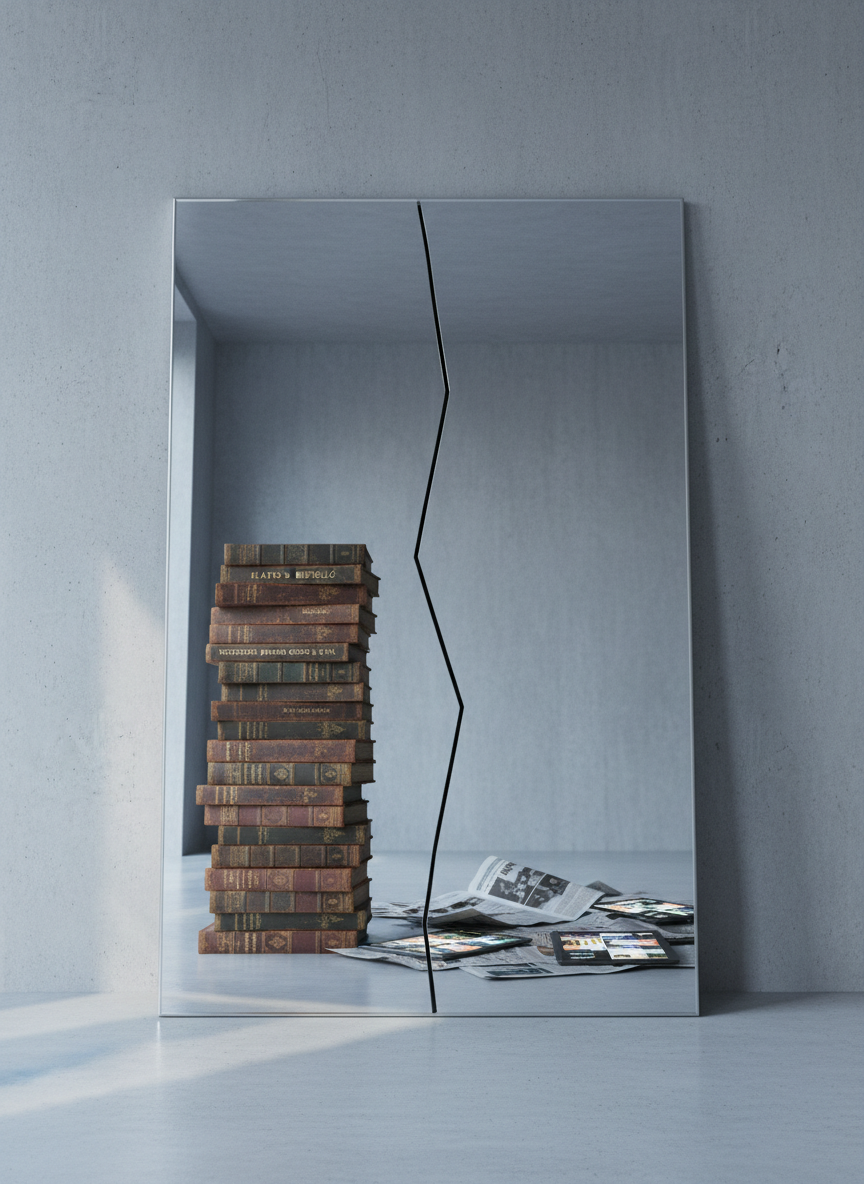
A pristine, frameless mirror cracked cleanly down the center, propped against a smooth concrete wall in a minimalist interior. On one side of the mirror’s reflection lies a meticulously ordered stack of philosophy books with embossed titles, on the other side a scattered spread of newspapers and digital tablets displaying blurred headlines. Soft, cool daylight filters through an unseen window, creating subtle reflections along the fractured glass and a gentle glow on the concrete texture. Photographic realism, composed using the rule of thirds with the crack as the visual anchor. The atmosphere is introspective and cerebral, suggesting a rupture between perception and reality, with quiet tension and sophistication in the neutral tones and precise arrangement.

Ideas Lab

Essays, provocations, and tools for questioning the stories that quietly govern everyday social life.

About

Rethinking Society Through Clear Seeing

KnowRevolution explores how hidden assumptions shape power, community, and self. Through accessible essays and thought experiments, we train attention to cut through noise—so perception becomes sharper, choices more deliberate, and social change grounded in clear seeing.

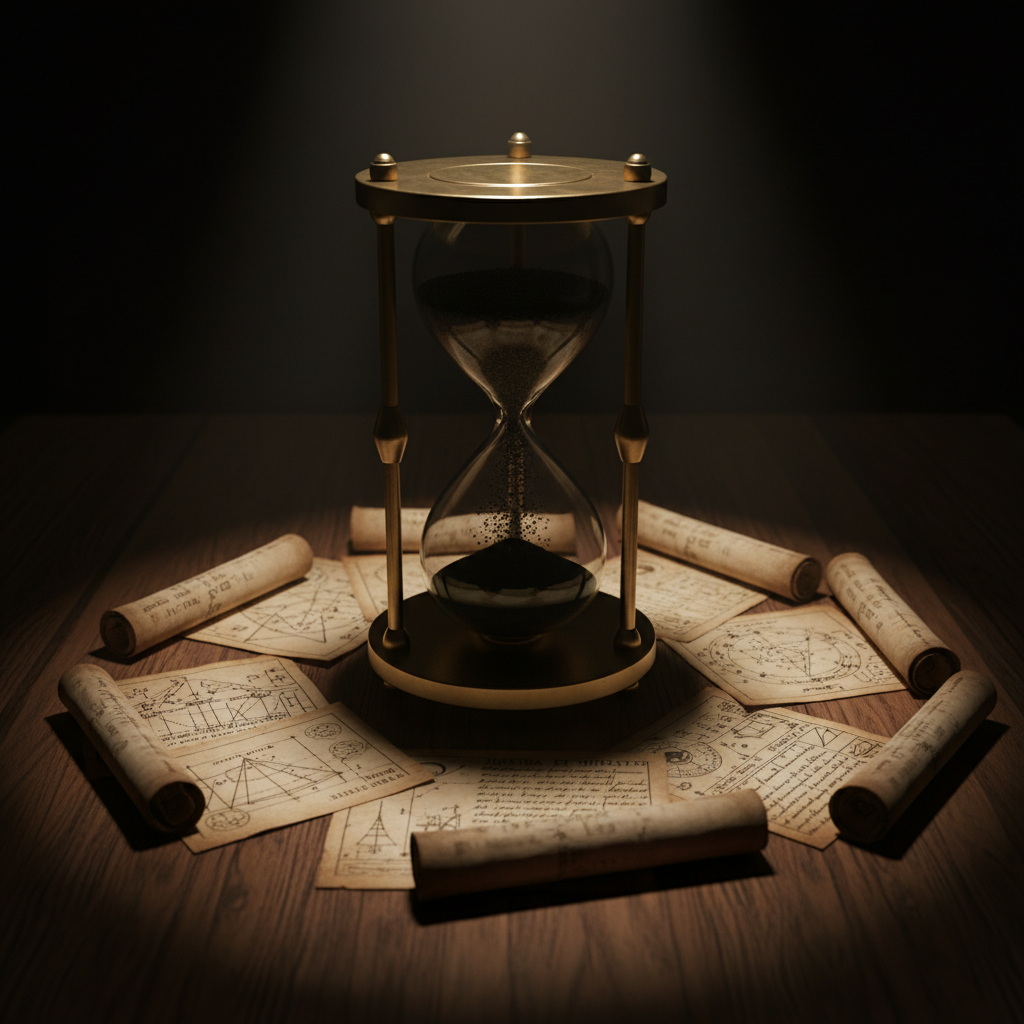
An intricately detailed hourglass made of smoked glass and brushed brass, suspended just above a dark wooden surface, grains of onyx-black sand frozen mid-fall between chambers. Around it, arranged in a loose spiral, lie faded parchment pages filled with geometric diagrams and marginalia about justice, power, and knowledge. A single, warm-edged spotlight from above carves out a circle of illumination, leaving the outer edges of the frame in velvety shadow. Photographic realism, shot from a slightly elevated angle with a medium depth of field to keep both hourglass and surrounding texts crisp. The mood is enigmatic and sophisticated, evoking the slow revolution of ideas over time and the weight of intellectual history.

The Mind

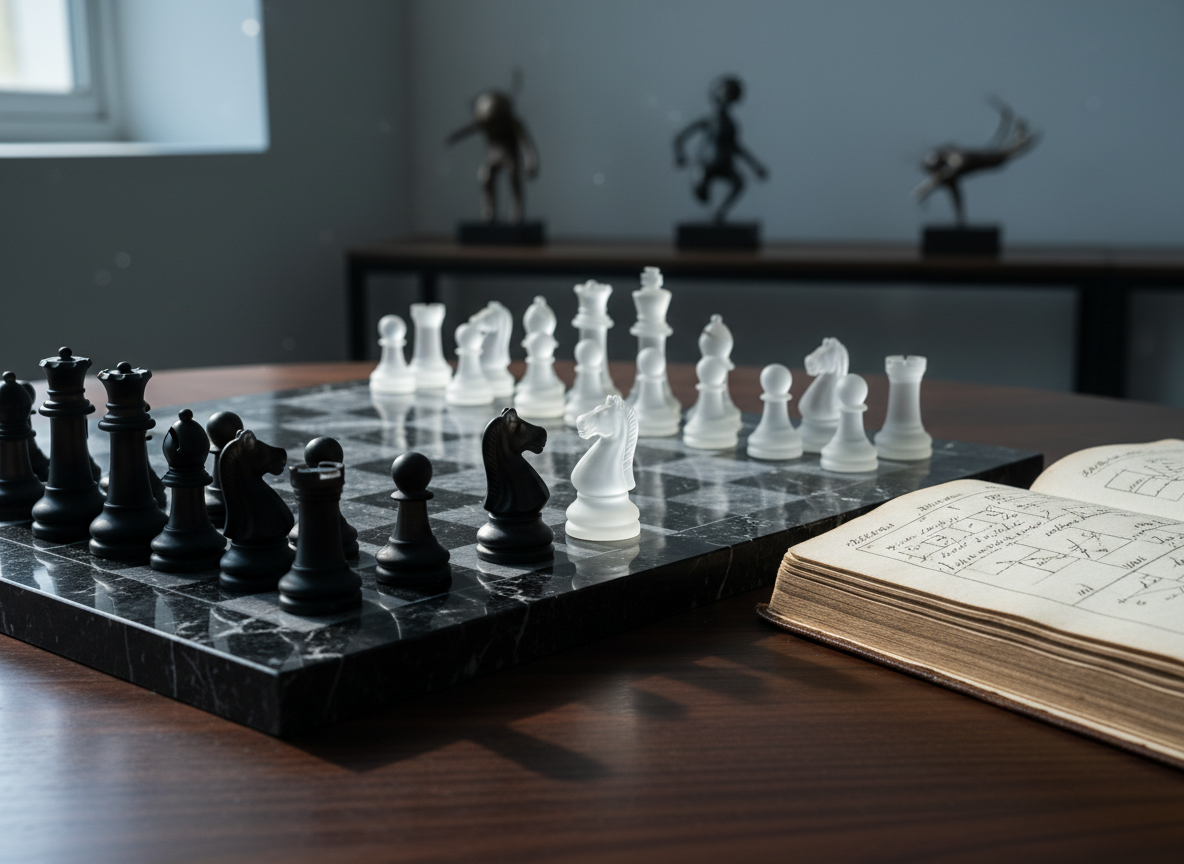
A sleek black marble chessboard with matte obsidian and frosted glass pieces frozen mid-game, knight and queen poised in a tense standoff near the center. The board rests on a dark walnut table beside an open, leather-bound notebook filled with precise, handwritten philosophical diagrams. Cool, diffused window light from the left creates sharp yet elegant shadows of the pieces, emphasizing their sculptural forms. In the softly blurred background, minimalist shelves hold a few abstract metal sculptures. Photographic realism, shot at eye level with a shallow depth of field, the focus razor-sharp on the contested central squares. The mood is sophisticated, contemplative, and slightly dramatic, capturing the feel of strategic thought piercing everyday perception.

Aarav Sharma

A pristine, frameless mirror cracked cleanly down the center, propped against a smooth concrete wall in a minimalist interior. On one side of the mirror’s reflection lies a meticulously ordered stack of philosophy books with embossed titles, on the other side a scattered spread of newspapers and digital tablets displaying blurred headlines. Soft, cool daylight filters through an unseen window, creating subtle reflections along the fractured glass and a gentle glow on the concrete texture. Photographic realism, composed using the rule of thirds with the crack as the visual anchor. The atmosphere is introspective and cerebral, suggesting a rupture between perception and reality, with quiet tension and sophistication in the neutral tones and precise arrangement.

Mateo García

An intricately detailed hourglass made of smoked glass and brushed brass, suspended just above a dark wooden surface, grains of onyx-black sand frozen mid-fall between chambers. Around it, arranged in a loose spiral, lie faded parchment pages filled with geometric diagrams and marginalia about justice, power, and knowledge. A single, warm-edged spotlight from above carves out a circle of illumination, leaving the outer edges of the frame in velvety shadow. Photographic realism, shot from a slightly elevated angle with a medium depth of field to keep both hourglass and surrounding texts crisp. The mood is enigmatic and sophisticated, evoking the slow revolution of ideas over time and the weight of intellectual history.

Zuri Ndlovu

A sleek black marble chessboard with matte obsidian and frosted glass pieces frozen mid-game, knight and queen poised in a tense standoff near the center. The board rests on a dark walnut table beside an open, leather-bound notebook filled with precise, handwritten philosophical diagrams. Cool, diffused window light from the left creates sharp yet elegant shadows of the pieces, emphasizing their sculptural forms. In the softly blurred background, minimalist shelves hold a few abstract metal sculptures. Photographic realism, shot at eye level with a shallow depth of field, the focus razor-sharp on the contested central squares. The mood is sophisticated, contemplative, and slightly dramatic, capturing the feel of strategic thought piercing everyday perception.

Leila Haddad

Reviews

A pristine, frameless mirror cracked cleanly down the center, propped against a smooth concrete wall in a minimalist interior. On one side of the mirror’s reflection lies a meticulously ordered stack of philosophy books with embossed titles, on the other side a scattered spread of newspapers and digital tablets displaying blurred headlines. Soft, cool daylight filters through an unseen window, creating subtle reflections along the fractured glass and a gentle glow on the concrete texture. Photographic realism, composed using the rule of thirds with the crack as the visual anchor. The atmosphere is introspective and cerebral, suggesting a rupture between perception and reality, with quiet tension and sophistication in the neutral tones and precise arrangement.

Aya Nakamura

KnowRevolution gave me language for tensions I’d felt for years, and a framework to challenge them without losing compassion.

An intricately detailed hourglass made of smoked glass and brushed brass, suspended just above a dark wooden surface, grains of onyx-black sand frozen mid-fall between chambers. Around it, arranged in a loose spiral, lie faded parchment pages filled with geometric diagrams and marginalia about justice, power, and knowledge. A single, warm-edged spotlight from above carves out a circle of illumination, leaving the outer edges of the frame in velvety shadow. Photographic realism, shot from a slightly elevated angle with a medium depth of field to keep both hourglass and surrounding texts crisp. The mood is enigmatic and sophisticated, evoking the slow revolution of ideas over time and the weight of intellectual history.

Mateo García

These essays don’t preach; they invite. I leave each piece seeing my relationships and politics with unsettling new clarity.